Tuesday, 8 December 2020

28mm Hessians: 1760-63 KR2 Gens d'Armes


 In 1760 the four Reiter regiments of cavalry were converted by the new Landgraf to cuirassiers although, according to Kronoskaf, they were not given cuirasses until after the end of the war. In my army they have them. Actually you would be hard-pressed to find miniature figures without the cuirasse and the nearest example would be 1806 Prussian cuirassiers although the bicorne would need to be replaced.

This is quite a pretty regiment in my view and the Black Hussar figures are lovely. You even get a choice with each figure of 4 different right arms.

I decided that the flags for this regiment shown on Kronoskaf were clearly pre-1760. There is a clue in a regimental plate (I would guess late 1760s to 1770s) for the Dragoon regiment Dalwigk as to what the cuirassier flags might have looked like. It is strange that all Hessian dragoons carried the swallow-tailed standard except for this Dalwigk which suggests that at some date the 4 cuirassier regiments might have been converted to dragoons. But I have no further information on this, suffice to say that the Dalwigk flag will form the basis of the new flags for the 4 Hessian cuirassier regiments. Stylistically, they fit in with my other Hessian flags.

In 1760 the four Reiter regiments of cavalry were converted by the new Landgraf to cuirassiers although, according to Kronoskaf, they were not given cuirasses until after the end of the war. In my army they have them. Actually you would be hard-pressed to find miniature figures without the cuirasse and the nearest example would be 1806 Prussian cuirassiers although the bicorne would need to be replaced.

This is quite a pretty regiment in my view and the Black Hussar figures are lovely. You even get a choice with each figure of 4 different right arms.

I decided that the flags for this regiment shown on Kronoskaf were clearly pre-1760. There is a clue in a regimental plate (I would guess late 1760s to 1770s) for the Dragoon regiment Dalwigk as to what the cuirassier flags might have looked like. It is strange that all Hessian dragoons carried the swallow-tailed standard except for this Dalwigk which suggests that at some date the 4 cuirassier regiments might have been converted to dragoons. But I have no further information on this, suffice to say that the Dalwigk flag will form the basis of the new flags for the 4 Hessian cuirassier regiments. Stylistically, they fit in with my other Hessian flags.

Friday, 13 November 2020

28mm Hessians: 1760-63 Regiment Mansbach 2nd BTN


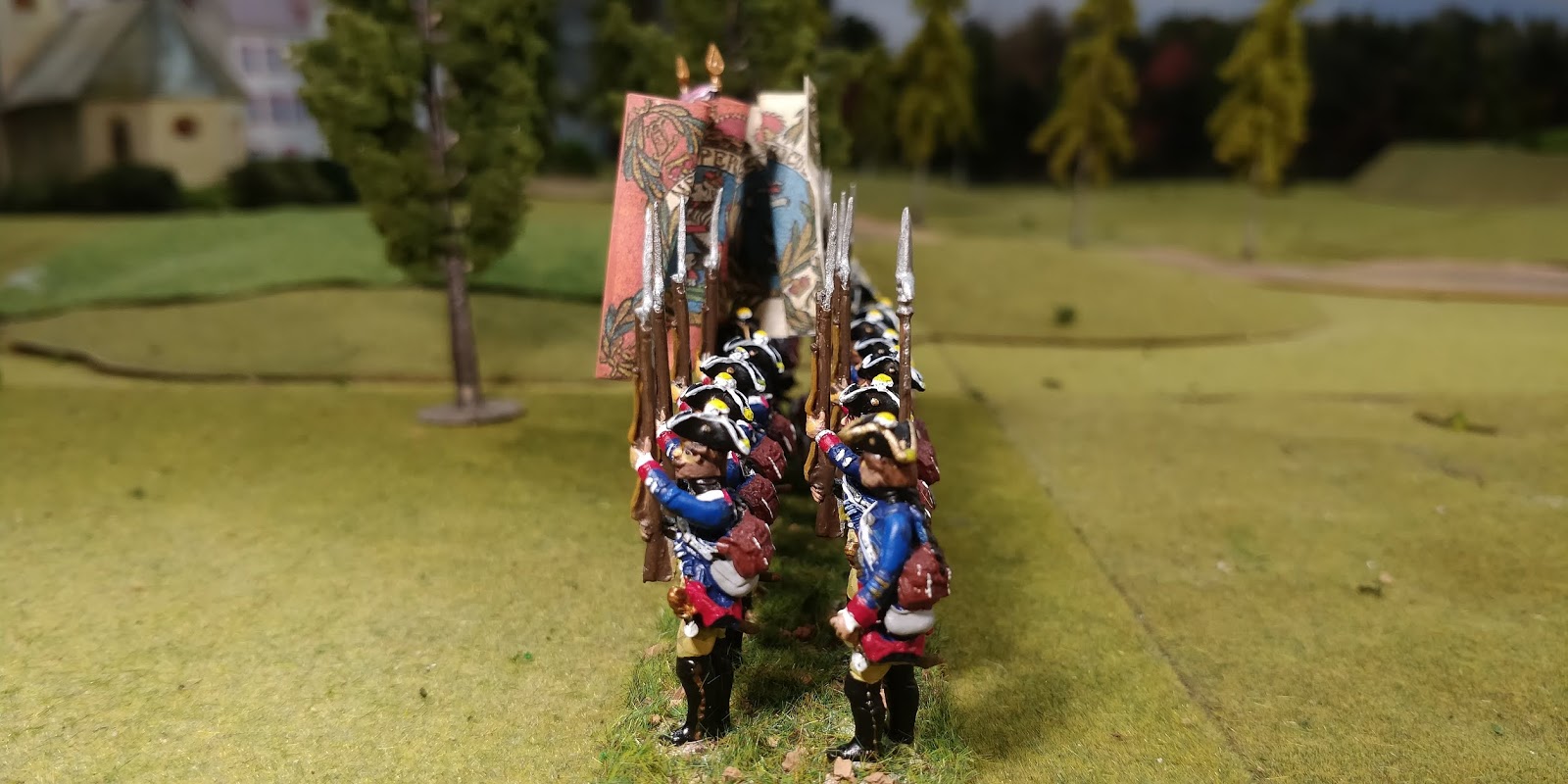
Here is the second battalion of this regiment and the last picture shows both battalions together. On my desk at the moment is the converged grenadier battalion with those from Wutginau and Mansbach,

Here is the second battalion of this regiment and the last picture shows both battalions together. On my desk at the moment is the converged grenadier battalion with those from Wutginau and Mansbach,

Tuesday, 13 October 2020

A short history of the Grafschaft (County of) Hessen-Hanau 1760-1821


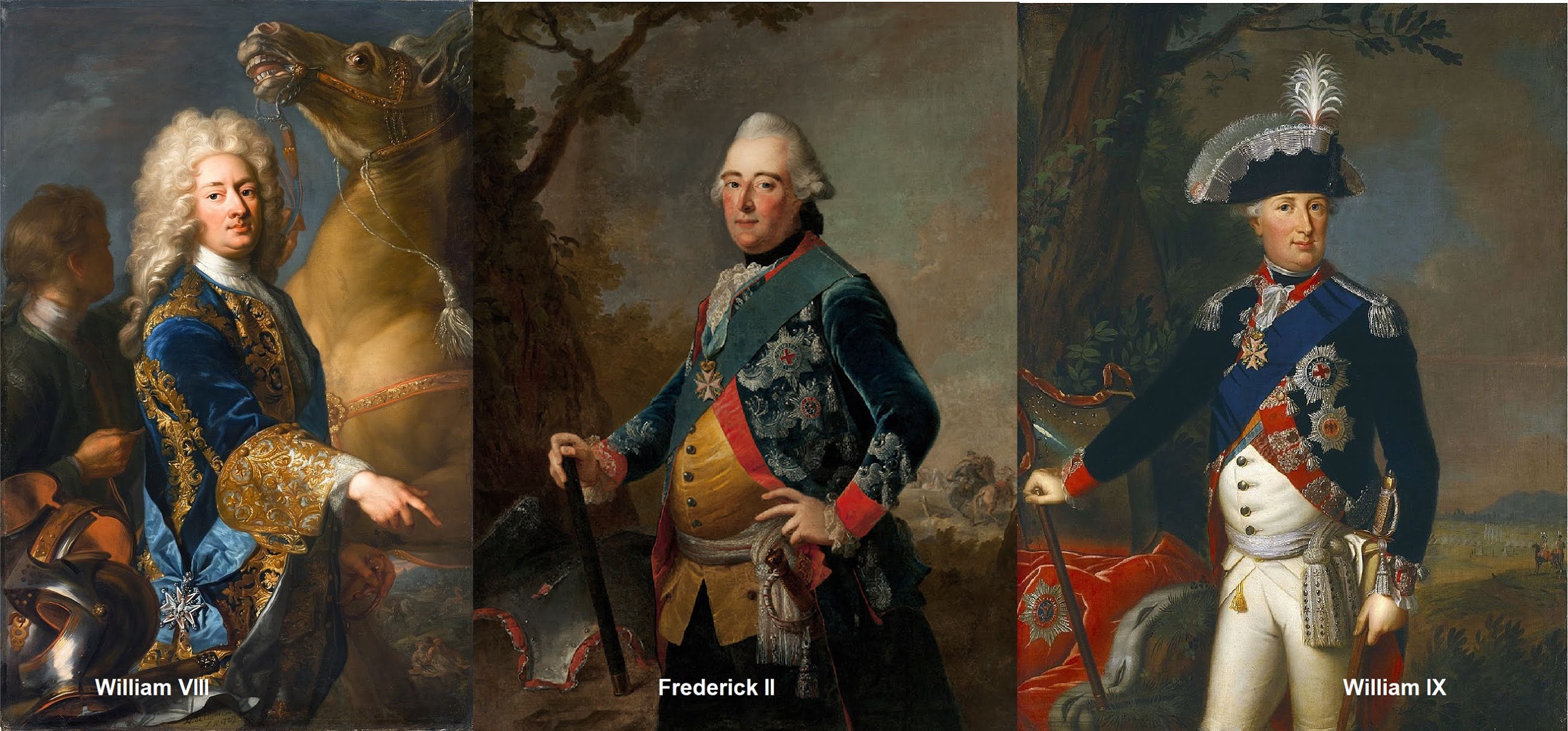
This is a story of family rows and intrigue that centres on three generations of the family that ruled Hesse-Kassel – William VIII, his son Frederick II and his grandson William IX. The history books don't go into their personal relationships but you can read between the lines


When the hereditary prince of Hesse-Cassel, Frederick (later to be Frederick II) , converted to Roman Catholicism in 1747, and, incidentally, abandonned his family, his father, the reigning landgrave William VIII decided to do what he could to limit his son's future realm. He therefore made the county of Hanau-Münzenberg, which had been part of Hesse-Cassel since 1736, a secundogeniture of Hesse-Cassel, transferring it to his grandson William. A secundogeniture (from Latin:secundus "following, second," and genitus"born") was a dependent territory given to a younger son of a princely house and his descendants, creating a cadet branch. This was a special form of inheritance in which the second and younger son received more possessions and prestige than he would have normally under the rules of primogeniture. It avoided the division of the estate and gave younger branches a stake in the stability of the house.


As count William was underage, his mother the landgravine, princess Mary of Great Britain, ruled as his legal guardian. His childhood was mostly spent in Denmark. After his accession to the throne of Hesse-Cassel in 1760, landgrave Frederick II repeatedly tried to re-unite Hesse-Hanau with Hesse-Cassel, but his efforts failed due to the resistance of Great Britain and the Protestant estates. As further protection, troops from Hanover were garrisoned in Hanau. When William came of age in 1764 he took over the government of the county. Two years later he signed an agreement with Great Britain to supply troops when necessary. Both he and his father waived the taxes of families of men who would serve in America. Had father and son been reconciled by then?


At the death of Frederick II in 1785, William became landgrave of Hesse-Cassel. The government of Hesse-Hanau remained in general separate from Hesse-Cassel. Cabinet and war office were, however, merged with those in Hesse-Cassel, and the court of appeal of Cassel got jurisdiction over Hanau in 1792. Until then Hesse-Hanau was ruled as an independent state, undergoing extensive modernizations with the erection of significant buildings in the capital of Hanau. Money for this came from the subsidies the reigning count received from his uncle, king George III of Great Britain. In return, Hesse-Hanau made available a contingent of 2,400 soldiers for the use of the British Crown in the American Revolutionary War.

Saturday, 22 August 2020

28mm Hessians: 1760-63 Regiment Mansbach 1st BTN


First battalion using Black Hussar figures. White facings are always slightly tricky to paint.


Wednesday, 17 June 2020

28mm Hessians: 1760-63 Regiment Wutginau 2nd BTN


Here is the second battalion of the regiment I recently posted here. I really like the Black Hussar pose.

Thursday, 4 June 2020

1760-63 Regiment Wutginau 1st BTN


These are figures (all except the Foundry officer) from Black Hussar and they are ones I have never used before. Normally I buy the marching pose but these are ‘Spannt den Hahn!’ which I am not going to translate. They are trickier to paint but I really like the pose which looks like they mean business.

I have used the flags from the plate which you can also see here. It is undated but I believe the plate (and there are others in this range) dates from anywhere from 1760 to the start of the AWI. Note that none of these flags are those used in the AWI so my guess is that they were the transitional flags before the AWI issue. I think that the names are misleading too. This regiment is named as Erbprinz and Wutginau became Erbprinz in 1776. The first Hessians arrived in America on August 15, 1776 so hardly enough time to change the flags to the newer and fancier AWI versions. I think the plates show the new flags issued in 1760 when Landgrave Friedrich II came to the throne.

This is the first battalion of two in the regiment.

Note: The Hessian Lion always points away from the flagstaff in this period.


Tuesday, 13 August 2019

Landgrenadierregiment/AWI Regiment Rall


In 1760, when the new Landgrave Friedrich II reorganised his army, the three former militia regiments were reorganised into three "Garrison Battalions" of 4 companies each, and one standing battalion of "Garrison Grenadiers" of 4 companies. This is the latter and by the AWI this is Grenadier Regiment Rall of Trenton fame.

You can see from the attached schematic that the uniform is basically the same although some coat lace has been added and the mitre's back colours has changed. The green flag has been somewhat embellished as per the 'Prussification' of the army. Further worthy of note is the fact that while the mitre rear of other ranks was piped white, this piping is gold for NCOs.

This one-battalion regiment fought at the Battle of Warburg. In my Hessian army the regiments are normally of 2 battalions each of 500 men (5 bases per battalion) whereas I have made this stronger with 7 bases or 700 men. Figures are mostly Black Hussar with command from Foundry.

Friday, 16 November 2018

Regiment Prince Karl


Here is the second regiment for my Hessian SYW army, Prince Karl. The Inhaber of this regiment remained the same person for the SYW through the AWI. There is also a well known painting of the regiment which shows an incident at the battle of Krefeld. Kronoskaf says “ On June 23, the regiment took part in the Battle of Krefeld where it was deployed on the right wing under the command of the Hereditary Prince. Towards the end of the battle, the Hereditary Prince and Gilsa rallied the battalion along with Wutginau Infantry and other Allied infantry units and advanced onto the plain. The Comte de Gisors at the head of 4 squadrons of the Corps des Carabiniers de Monsieur le Comte de Provence charged these advancing battalions who let them close in to about 20 paces before firing a devastating volley mowing down in an instant most of the first rank. A single squadron managed to break through but the third rank of infantry knocked it down (ie turned round)”.

My flags here are the AWI ones which are probably the wrong style of flags because at the time of the battle (1758) the regiment was a one battalion regiment with different plainer flags.

Note also that during the SYW this regiment had silver buttons and white lapel lace. By the AWI, the regiment had yellow buttons and lapel lace. I do not know when the change was made but I have gone for the SYW colour scheme.


I have compiled a painting card to assist you in painting this regiment.

Wednesday, 10 October 2018

Hessian SYW K1 Erbprinz Cuirassiers


I have feilded these as cuirassiers in their post-1760 uniform. Although they were converted to cuirassiers the actual cuirasse does not appear to have been issued until after the end of the SYW. But I wanted to use the latest offerings from Black Hussar and so these are actual cuirassiers. If you want Prussian (or lesser smaller states') Cuirassiers then these are the best you can buy in 28mm. Each figure comes with a variety of sword arms you can chose from.

Hessian SYW 7/9 Mirbach Grenadiers


These are slightly different, in composition, from the original converged grenadier battalion which was grenadiers from regiments 7 and 11. These are from regiments 7 and 9 which I am fielding. I love these Black Hussar figures.


Tuesday, 31 October 2017

Hessian Leib Regiment


Regular readers of this blog will know that I am slightly obsessed with 18th century Hessians. This blog focused on Hessians in the early SYW but these new posts will concentrate on the late war. What I like about them is that they are a Prussian looking army but much smaller and feasible given that I have to paint both sides if I embark on a project. Add to that the fact that my second favourite army of this bewigged century is the French. Who could possible manufacture both sides? Well I am teasing you because my favourite manufacturer is Black Hussar who, incidentally, produce both Prussians and French for the SYW. The imminent arrival of Prussian Cuirassiers is most welcome too.

So here is the start of a small project (Hessians v French) for late SYW. When I say small, I mean similar sized to the WAS in Italy project which consists of about 12 battalions and 12 squadrons each side.

The other thing I like about Hessians are their bewilderingly colourful AWI flags. In 1760 the old Landgraf passed away and his son Friedrich II came to the throne. He was a Prussian General and inhaber of a Prussian Infantry regiment too. Already quite Prussian in it's look, he tinkered with the organisation and flags to make the army a mini-replica of his big neighbour to the East. The early flags, prior to 1760, I find a little bit dull. The post 1760 flags are much more Prussian in look but many details of what they looked like are unknown. With the AWI you would have thought that the fog of what the flags looked like might have lifted but sadly not. Many of the articles on the AWI flags captured are inconsistent with Prussian practice. A good article is here at

So what I am doing is a late SYW Hessian army with AWI flags. Some are conjectural as the Hessians only sent single battalions to North America whereas I will field double battalion regiments. Some questions remain as to what exactly was the colour combination of the Leibfahne and what was the colour combination of the Regimentfahne? I will try to follow the logic of the Prussian system but I admit there are many opposing views so this is just my interpretation. But you also have to just love the vibrant colour of the flags which came from http://FlagsofWar.com
Iain there is a great chap and he has resized the flags slightly for me so that they fit on the Black Hussar flagpoles. I think the artwork is even better than GMB's, which is saying something.


In terms of the uniforms, most will be based on the SYW late version but with this first regiment, I have gone with the AWI uniform. The late SYW version had pink facings which looked wrong with these flags whereas the sand/mustard yellow facings compliment the flags. And in the unlikely event that I ever do armies for the AWI, then these two battalions can be combined into one, less one set of flags.